
Introduction: The Cleaning Demands of Advanced IOL Materials
Are you struggling with microscopic residues and costly rework in your Intraocular Lens (IOL) manufacturing? The delicate surfaces of IOLs, meticulously crafted from hydrophobic and hydrophilic acrylic materials, are crucial for maintaining clear vision and long-term stability within the eye. Yet, their soft, sometimes tacky surfaces are notoriously prone to retaining machining-generated residues and particles, such as polishing compounds or metallic debris. This poses significant cleaning challenges during the manufacturing process.
Ensuring particle-free, undamaged IOL surfaces is not just an ideal—it’s essential. Even a single microscopic scratch or residual particle can lead to costly rejects.
Sterile saline solution is the primary cleaning agent for IOLs, prized for its compatibility with lens materials and the absence of chemical residues that could compromise biocompatibility. However, saline’s low solvency means effective removal of these machining residues relies heavily on the swab’s absorbency and pore structure. Traditional 100 PPI open-cell polyurethane foam swabs, long a standard in cleanroom environments, often lack the necessary absorbency for saline-based cleaning and frequently fail to meet critical ISO 10993 endotoxin requirements. This leads to inefficiencies, higher scrap rates, and significant compliance risks.
Leveraging decades of expertise in critical cleaning, Foamtec engineered UltraSOLV swabs as a transformative solution. With their proprietary hydrophilic foam and variegated pore structure, UltraSOLV swabs demonstrably outperform standard 100 PPI open-cell foam, delivering scratch-free, ISO 10993-compliant cleaning that efficiently removes stubborn machining residues and dramatically boosts IOL production yields.
Why 100 PPI Open-Cell Foam Swabs Fall Short for IOLs
For years, 100 PPI open-cell polyurethane foam swabs have been a go-to choice in cleanrooms, driven by their historical availability. However, they are fundamentally ill-suited for the rigorous demands of saline-based IOL cleaning due to several critical limitations:
- Low Absorbency & Inefficient Particle Pickup: 100 PPI open-cell foam is inherently hydrophobic or only semi-hydrophilic, severely limiting its ability to wick and hold saline effectively. This directly translates to reduced particle pickup efficiency, leaving critical machining-generated contaminants, such as polishing compounds or metallic particles, stubbornly clinging to the lens surface.
- Uniform Pore Structure Limitations: The uniform pore size of traditional 100 PPI open-cell foam limit its ability to efficiently trap and retain sticky or metallic manufacturing debris. Instead of capturing contaminants, these swabs often smear particles across the delicate device, necessitating costly rework and impacting throughput.
- Non-Compliance with ISO 10993 Endotoxin Standards: Unlike Foamtec UltraSOLV, 100 PPI open-cell foam swabs typically fail to meet the stringent ISO 10993 endotoxin requirements. For ocular implants, where biocompatibility is non-negotiable and direct patient contact is involved, this poses significant regulatory and patient safety risks.
- High Risk of Scratching Delicate Surfaces: The often uneven foam surfaces and poorly sealed tips characteristic of 100 PPI swabs significantly increase the risk of scratching delicate IOL surfaces, particularly in low-lubricity saline environments. This directly reduces device yield and leads to unnecessary material waste.
These critical shortcomings lead to higher scrap rates and substantial production inefficiencies for IOL manufacturers. This highlights the urgent need for a superior, purpose-built cleaning solution.
UltraSORB Swabs: Engineered for Saline-Based IOL Cleaning Precision
Foamtec’s UltraSORB swabs are meticulously designed and engineered to surpass every limitation of 100 PPI open-cell foam swabs in saline-based IOL cleaning environments:
- Hydrophilic, Advanced Open-Cell Foam: UltraSOLV’s proprietary hydrophilic polyurethane foam rapidly absorbs and uniformly distributes saline. This ensures unparalleled wetting and highly efficient lifting of even microscopic machining-generated residues, providing a stark contrast to the poorly absorbent 100 PPI foam.
- Variegated Pore Network for Superior Debris Capture: Unlike uniform foams, UltraSOLV’s varied, open pore structure creates natural, microscopic pockets. These pockets are designed to effectively capture and securely lock in a wide range of debris, including hard, metallic particles from machining processes, without risk of redeposition or scratching. This unique structure is ideal for precisely cleaning curved IOL optical zones, significantly improving device yield by drastically reducing defects.
- Unmatched Scratch-Free Performance: The incredibly soft, compliant foam of UltraSOLV swabs gently conforms to delicate IOL surfaces. This minimizes any risk of scratching, even during rigorous or repeated cleaning, thereby preserving the critical optical clarity of every lens.
- Full ISO 10993 Compliance & Cleanroom Production: Manufactured and packaged in state-of-the-art ISO Class 5 cleanrooms, UltraSOLV swabs are rigorously validated to meet comprehensive ISO 10993 standards for cleanliness, cytotoxicity, and endotoxins. This ensures absolute regulatory compliance and peace of mind, a critical advantage over non-compliant 100 PPI foam swabs.
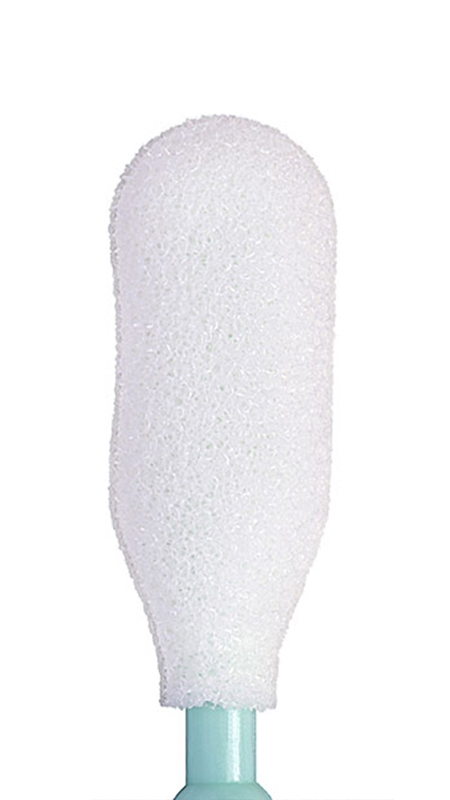 Competitor Foam Swab Tip |
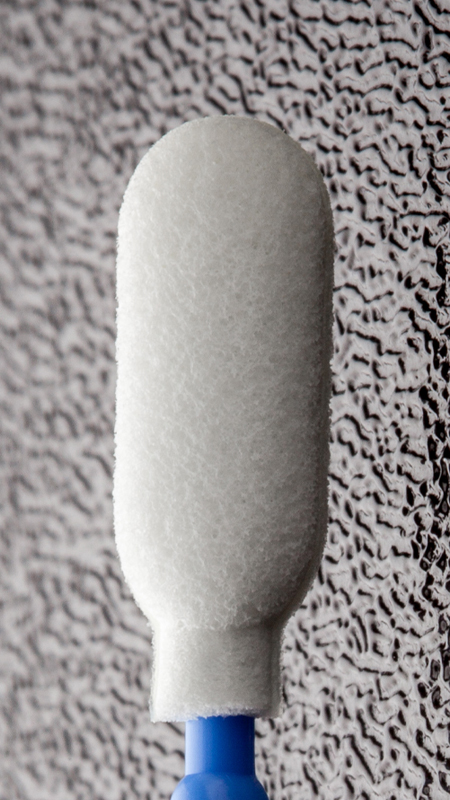 UltraSOLV Foam Swab Tip – HT1701MD |
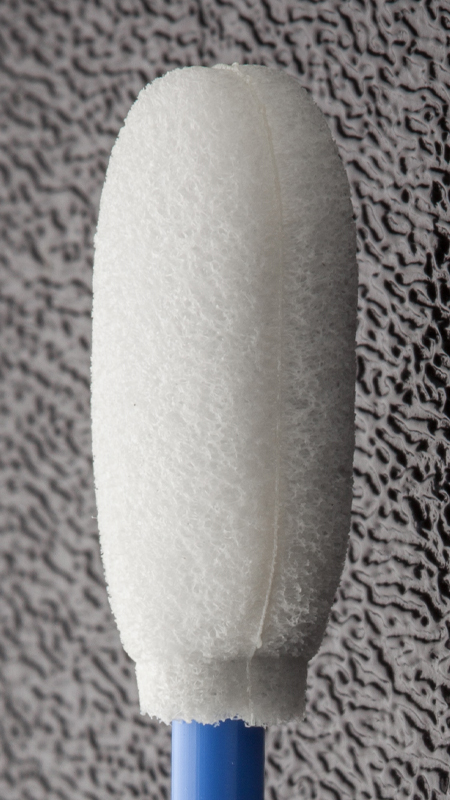 UltraSOLV Foam Swab Tip – HT1702 |
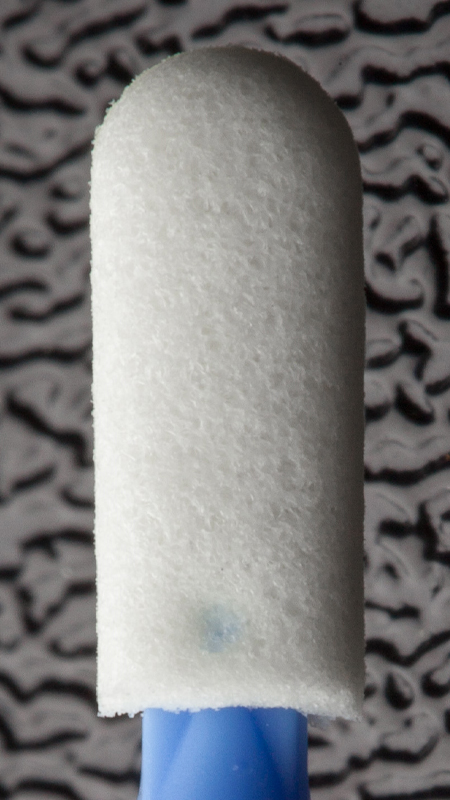 UltraSOLV Foam Swab Tip – HT1729 |
In IOL manufacturing, flawless surfaces are non-negotiable. As we’ve seen, a single microscopic scratch or residual particle can lead to devastating vision issues or immediate regulatory rejection. UltraSORB swabs fundamentally optimize the saline-based cleaning process by combining superior absorbency with a groundbreaking variegated pore structure.
This powerful combination enables them to efficiently remove all types of machining residues, from polishing compounds to metallic debris. The result?
- Significantly Reduced Rework and Scrap Rates: By effectively removing contaminants on the first pass, the need for costly reprocessing or discarding of lenses is drastically minimized.
- Enhanced Device Yields: Cleaner lenses mean more usable IOLs per production batch, directly impacting your bottom line and increasing manufacturing efficiency.
- Guaranteed ISO 10993 Compliance: Mitigate regulatory risks and ensure patient safety with a cleaning solution validated explicitly for biocompatibility and cleanliness.
This comprehensive advantage sets UltraSOLV apart from standard 100 PPI open-cell foam swabs, which often drag particles or leave contaminants behind, leading to ongoing production headaches.
Conclusion: Elevating IOL Cleaning Standards for the Future
For IOL manufacturers relying on saline-based cleaning, Foamtec’s UltraSOLV swabs provide a truly transformative alternative to outdated 100 PPI open-cell foam swabs. Their unique hydrophilic foam, innovative variegated pore structure, and unwavering ISO 10993 compliance ensure the most efficient removal of machining residues, minimize surface damage, and significantly enhance production yields.
If your cleanroom operation demands pristine IOL surfaces, UltraSOLV is the critical upgrade your process needs to achieve unmatched quality and efficiency.
Ready to Optimize Your IOL Cleaning? Request Your UltraSOLV Swab Samples Today!
Contact Foamtec to experience the UltraSOLV difference firsthand and elevate your IOL production standards.
Note: This blog post is for informational purposes and based on Foamtec’s product innovations. Always consult regulatory experts for specific compliance needs related to medical device manufacturing.