
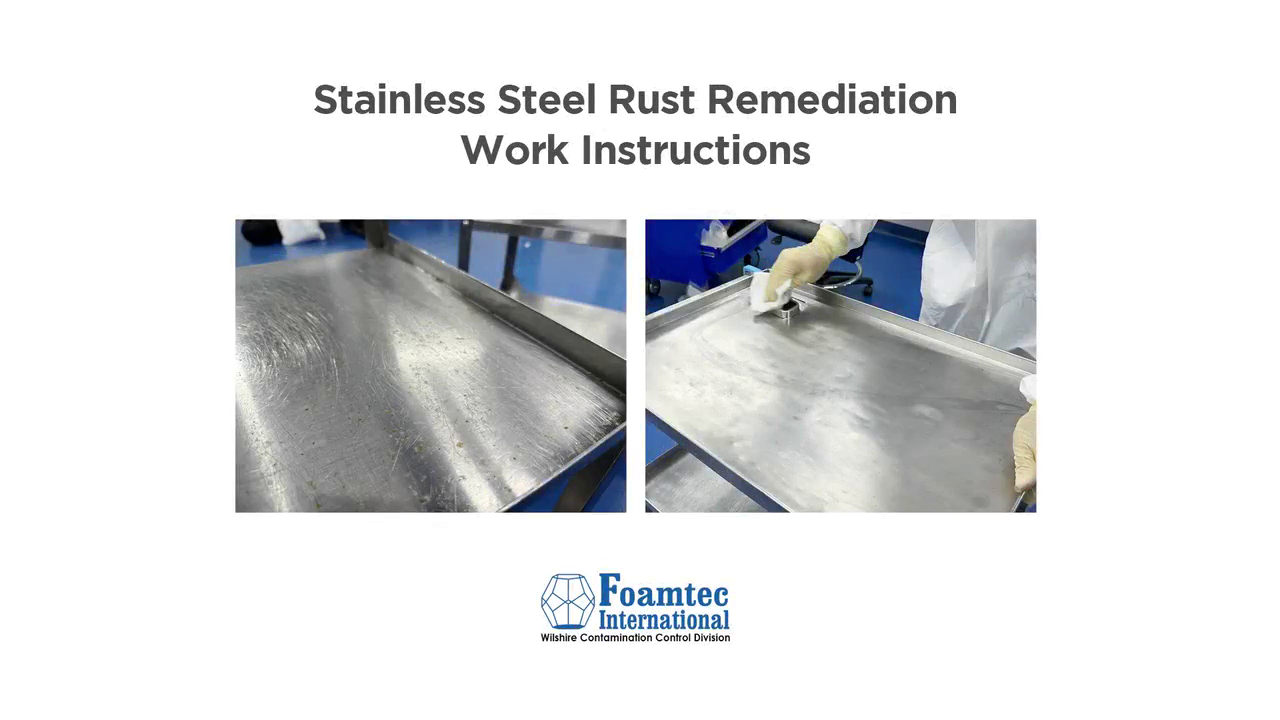
Rust and corrosion on stainless steel equipment present significant challenges for quality engineers in GMP facilities. Beyond the visible damage, these issues introduce various risks that can compromise product quality, regulatory compliance, and personnel safety. This blog post examines the key risk assessment considerations for rust and corrosion and how Foamtec’s Sahara Remediation products offer a safer, more controlled, and validated approach.
Key Risk Assessment Considerations for Quality Engineers:
Quality engineers must thoroughly evaluate the risks associated with rust and corrosion remediation, considering the following factors:
- Material Compatibility: What type of stainless steel is affected? Different grades react differently to cleaning agents and abrasive methods. Using the wrong approach can cause further damage, pitting, or discoloration.
- Corrosion Severity: Is it surface rust, pitting, or crevice corrosion? The severity dictates the appropriate remediation method. Aggressive methods may be necessary for severe corrosion but also carry higher risks.
- Contamination Potential: Rust and corrosion particles and residues from cleaning agents pose a significant contamination risk. How can this risk be minimized and effectively controlled? What impact could these contaminants have on product quality and sterility?
- Safety Hazards: Many traditional rust removal methods involve harsh chemicals that pose safety risks to personnel. What are the potential hazards (chemical burns, inhalation), and how can they be mitigated?
- Environmental Impact: Disposal of chemical waste from rust removal can have ecological implications. Are there regulations governing waste disposal, and how can the environmental impact be minimized?
- Validation Requirements: Cleaning and disinfection procedures in GMP facilities must be validated. How can the chosen rust removal method be validated to ensure its effectiveness and prevent contamination?
- Surface Finish Requirements: Does the stainless steel require a specific surface finish (e.g., a 10ra finish)? Can the chosen method achieve and maintain this finish without damaging the surface?
- Equipment Downtime: How long will the rust removal process take? What impact will this have on production schedules and equipment availability?
The Significant Risks of Commercial Rust-Busting Chemicals in GMP Environments:
Commercial rust-busting chemicals, particularly those with a strong acid-base, introduce several critical risks that quality engineers must address, especially concerning their potential to generate fumes:
- Fume Generation and Cross-Contamination: Many commercial rust removers release fumes that can travel throughout the facility, potentially contaminating other areas and products. These fumes can be challenging to contain and may require extensive ventilation or air filtration to mitigate. This is a serious concern in aseptic regions where air quality is paramount.
- Material Incompatibility (Beyond the Immediate Surface): Fumes from harsh chemicals can react with materials beyond the immediate area of application, including sensitive equipment, electronics, or even packaging materials. This can lead to corrosion, damage, or degradation of these materials, even if they are not directly involved in rust removal.
- Personnel Safety (Inhalation Hazards): Inhaling fumes from strong acids can pose serious health risks to personnel, including respiratory irritation, chemical burns, and long-term health problems. Even with proper PPE, the risk of exposure remains a concern, especially in enclosed spaces or areas with limited ventilation.
- Residue Concerns (Fume Condensation): Fumes can condense on surfaces throughout the facility, leaving behind chemical residues that are difficult to detect and remove. This can lead to long-term contamination issues and require extensive cleaning and validation efforts.
- Validation Challenges (Fume Control): Validating the removal of chemical residues from fumes is exceptionally challenging. It’s difficult to ensure that all areas affected by the fumes have been adequately cleaned and that no residue remains.
The Limitations of Abrasive Pads and Their Associated Risks:
Traditional abrasive methods, such as *Scotch-Brite™ pads, also introduce risks:
- Particle Generation: *Scotch-Brite™ pads can generate particles that contaminate the cleanroom, leading to product defects and equipment malfunctions.
- Surface Damage: Aggressive scrubbing can scratch the surface, creating crevices that are difficult to clean and can harbor bacteria.
- Inconsistent Results: The manual nature of this method leads to inconsistent results.
Foamtec’s Sahara Remediation: A Risk-Mitigating Solution:
Foamtec’s Sahara Remediation products offer a compelling alternative that addresses many of the risks associated with traditional methods:
- Elimination of Harsh Chemicals: Sahara products primarily use USP water and 70% IPA, eliminating the need for harsh, fuming chemicals. This significantly reduces safety hazards, environmental impact, and residue concerns, including the risk of fume generation and cross-contamination.
- Controlled Abrasion: The specialized pads and sanding tool provide controlled abrasion, minimizing the risk of scratching or damaging the stainless steel surface.
- Minimized Particle Generation: Sahara products are designed to minimize particle shedding, reducing the risk of contamination in the cleanroom.
- Simplified Validation: The well-defined Sahara Remediation process makes validation easier.
- Improved Safety: Eliminating harsh chemicals significantly improves personnel safety and reduces the risk of environmental contamination.
The Foamtec Cleaning Process:
The Foamtec process, using ScrubPADs, UltraSOLV Sponges, and MiraWIPE Microfiber Wipers, provides a structured and controlled approach:
- ScrubPAD with USP Water: Removes the bulk of the rust or corrosion.
- UltraSOLV Sponge: Removes any remaining loosened debris and residual cleaning solution.
- MiraWIPE with 70% IPA: Polishes and dries the surface.
Conclusion: Investing in Risk Reduction with Foamtec:
For quality engineers in GMP facilities, rust and corrosion remediation is not just about removing the visible problem; it’s about mitigating the associated risks, especially those related to harsh chemicals and fume generation. Foamtec’s Sahara Remediation products offer a safer, more controlled, and validated approach. By choosing Foamtec, GMP facilities can protect product quality, ensure regulatory compliance, enhance personnel safety, and minimize equipment downtime. It’s an investment in a robust, risk-reducing solution.
Contact us today for more information:
*Scotch-Brite™ is a trademark of 3M.